
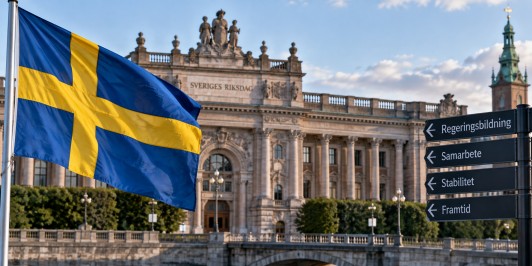
Following a tightly contested parliamentary election in Sweden, political parties are now navigating coalition negotiations. The centre-left bloc, led by the Social Democrats, holds a slight advantage over the right-leaning parties as they embark on the process of assembling a new government. As of now, with 95% of the votes counted, the centre-left has secured 176 parliamentary seats, narrowly ahead of the right bloc’s 173 seats. These figures could still shift as overseas votes are anticipated to be tallied later in the week.
Social Democrat leader Magdalena Andersson is actively engaging in talks to explore possible coalition formations, aiming to return her party to government. Meanwhile, outgoing Prime Minister Ulf Kristersson and his centre-right coalition partners are also considering their options to maintain their hold on power. The tight margin between the two blocs has introduced some uncertainty regarding the next government’s composition. The Centre Party is expected to play a pivotal role in the coalition discussions, although there are still unresolved issues about whether it can collaborate with the Left Party.
The Centre Party has expressed its desire for a stable government with a distinct centre-right orientation and has opposed working with what it deems as fringe political entities. On the other side, multiple left-leaning parties have shown interest in a government change and have cautioned against a prolonged political stalemate, which might necessitate another election. The Sweden Democrats, who had previously supported the outgoing right-wing government, experienced a decrease in support, making their participation in the next government unlikely. Despite this, their policies on immigration, integration, and crime have had a notable impact on mainstream political discussions.
Kristersson remains flexible in his approach while awaiting the final election outcome. The Moderates and their allies face the task of securing a viable parliamentary majority, especially with the Liberals and Christian Democrats ruling out any cooperation with the Social Democrats. The newly elected parliament is scheduled to convene on September 28, with the first possible vote for a prime minister set for the following day. Should efforts to elect a prime minister repeatedly fall short, Sweden might find itself heading towards another election.
The coalition formation process is likely to be lengthy, potentially taking several weeks or months. In 2022, it took 37 days to form a government post-election, while the 2018 election resulted in 134 days of negotiations. With neither bloc possessing a clear majority, the Centre and Left parties may play a decisive role in determining the makeup of Sweden’s next government.