
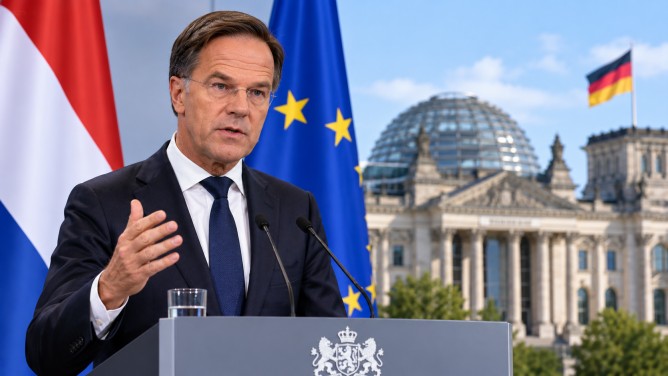
The recent electoral success of the far-right Alternative for Germany (AfD) in Saxony-Anhalt has been described as a “wake-up call” for German politics by Dutch Prime Minister Rob Jetten. Although he acknowledged that voters have the autonomy to choose their representatives, Jetten voiced concerns regarding the AfD’s extreme views and its seemingly pro-Russian tendencies. He urged political figures in Germany to delve into the reasons behind the AfD’s escalating support and to consider more effectively addressing voter discontent.
The AfD captured 43.8 percent of the vote in Saxony-Anhalt, narrowly missing an outright majority. Trailing behind were the Christian Democratic Union (CDU) with 17.2 percent, the Social Democratic Party (SPD) at 9.3 percent, the Greens with 8.9 percent, and Die Linke at 8.6 percent. Additionally, the BSW party managed to secure a position in the state parliament with 5.3 percent of the vote. The election results have sparked apprehension among European leaders, with officials from France and Poland indicating that the outcome underscores the mounting challenge posed by far-right political movements. Conversely, Hungary’s former prime minister, Viktor Orbán, expressed approval, congratulating the AfD on its performance.
Amid the election campaign, German officials raised alarms about potential threats to democratic principles and the increasing sway of Russian narratives. Reports of misinformation and foreign meddling further fueled the ongoing debate concerning the AfD’s rising popularity. The party has declared its intent to capitalize on the Saxony-Anhalt outcome, aspiring to become Germany’s largest political force at the national level. Alice Weidel, co-leader of the AfD, has ambitiously set a goal of achieving at least 40 percent of the vote in the next federal election.
Despite its robust showing in Saxony-Anhalt, the AfD lacks sufficient seats to govern independently. Many parties have refused collaboration due to the AfD’s contentious positions on issues like migration, casting doubt on the formation of a stable state government. The election has thus amplified discussions across Germany and Europe concerning the ascent of the far right, growing voter dissatisfaction, and the potential future trajectory of German politics.