
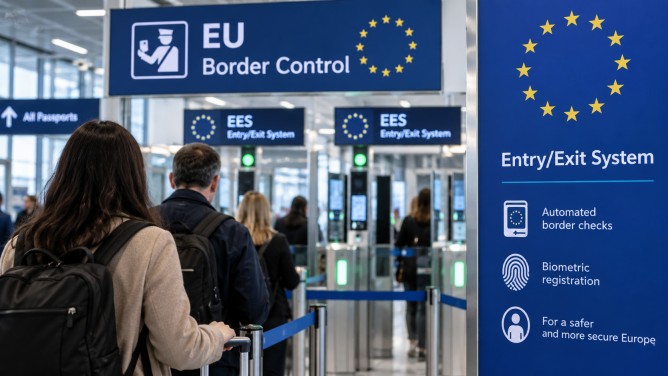
In an effort to streamline border security, the European Union’s ambitious Entry/Exit System (EES) faces delays in full implementation across several member states. Originally launched last October, the system requires non-EU travelers entering the Schengen area to undergo biometric checks, including fingerprinting and facial recognition. However, technical and operational challenges at major travel hubs have prompted nine European countries, including France, Greece, Italy, and Portugal, to seek additional time for a complete rollout.
The EES aims to enhance security by recording biometric data of travelers and has so far registered approximately 200 million entries, preventing around 70,000 unauthorized entries into the Schengen zone. These instances include individuals without valid visas, those who have overstayed their permitted duration, and travelers using counterfeit documents. Despite these achievements, countries like Germany, Malta, the Netherlands, Switzerland, and Belgium are also requesting extensions to address the logistical issues presented by busy airports and border crossings.
While Spain has successfully navigated initial difficulties and moved forward with full implementation, other nations have seen mixed progress. Some locations, such as the Eurostar terminals in Brussels and the port of Antwerp, have begun biometric checks, yet several airports, particularly smaller ones, still grapple with infrastructural challenges. Notably, major airports like Frankfurt and Schiphol are already conducting these checks, although the process remains uneven across the continent.
The International Air Transport Association has expressed concerns regarding potential travel disruptions, as the system might cause delays during peak travel periods. In response, airlines have warned of the possibility of extended queues. As part of a broader strategy to mitigate these issues, a pre-travel application known as Travel to Europe is being introduced. This tool allows travelers to submit their biometric data before reaching the border and is currently operational in Sweden and Portugal, with plans for expansion to other countries.
The ongoing adjustments to the EES underscore the complexities involved in modernizing border security across Europe. As the system continues to be fine-tuned, authorities remain focused on achieving a balance between enhanced security measures and maintaining efficient travel flow, especially during busy periods.